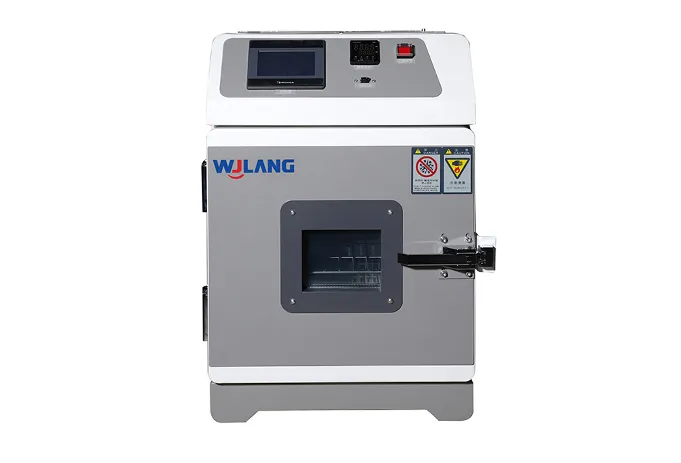
Benchtop Temperature and Humidity Test Chamber
Benchtop temperature and humidity test chamber features a vertical or horizontal structure, compact design, small size, and fast heating and cooling, making it an ideal benchtop thermal chamber and benchtop environmental chamber for space-constrained laboratories. It can also support moderate profiles as a benchtop thermal cycling chamber when humidity control is required alongside temperature ramps.
The benchtop temperature and humidity chamber, also suitable as a benchtop humidity chamber, adopts a Chinese and English touch controller for easy operation, with a communication connection function (Rs485), reflecting the control flexibility offered by experienced temperature chamber manufacturers.
The door of the benchtop temperature test chamber, a compact benchtop environmental test chamber, can change the opening direction according to the needs of work testing, and direct online testing can be carried out at the right place on the table. This flexibility distinguishes our benchtop temperature test chamber from conventional designs.
The benchtop temperature and humidity chamber is suitable as a benchtop stability chamber for R & D units,office buildings and other online test constant temperature and humidity testing requirements, making it a versatile small environmental test chamber solution for diverse applications.
Specifications of Bench-Top Temperature and Humidity Chamber
Bench-Top Temperature and Humidity Chamber
Benchtop Temperature and Humidity Chamber vs Thermal Cycling Chamber
A benchtop temperature and humidity chamber is designed for controlled temperature and RH exposure in a compact workspace, while thermal cycling equipment is selected when repeated temperature ramps and faster heating or cooling are central to the test method. WJLANG’s bench-top humidity model focuses on stable temperature and humidity control, whereas its rapid-rate products are designed around faster temperature change. If the test requires repeated ramping rather than humidity conditioning, compare a benchtop thermal cycling chamber before specifying the compact humidity model. For routine compact-sample conditioning, a benchtop environmental chamber is the more direct fit when its 22 L or 30 L workspace and stated temperature/humidity range cover the specimen and test profile.
How to Choose a Benchtop Environmental Chamber for Limited Lab Space
A benchtop environmental chamber is most suitable when test samples are compact and the chamber must operate close to the R&D bench or production line. WJLANG’s current bench-top models use 22 L or 30 L inner volumes, while the door opening direction can be adjusted according to the test setup. When evaluating a benchtop environmental test chamber, buyers should first confirm specimen dimensions, required cable access, the temperature and humidity profile, and whether the sample releases heat during operation. If the project needs more workspace or a broader choice of compact configurations, compare the related small environmental test chamber range before final model selection. Choosing by external size alone can leave insufficient airflow clearance around the specimen. When the primary need is repeated temperature ramps in a compact footprint, a dedicated benchtop thermal cycling chamber should also be evaluated.
How Sample Load and Airflow Affect Benchtop Stability
Compact volume makes sample placement more important. A benchtop stability chamber should not be evaluated only by empty-chamber temperature values, because large fixtures, closely packed samples, or energized specimens can affect airflow and recovery. WJLANG lists a temperature distribution deviation of ±1°C within -40°C to 100°C and ±2°C outside that range for the current bench-top models. Users should leave clearance around the specimen and confirm acceptance points under the intended load. If humidity control is not required and the method needs only compact temperature exposure, compare the dedicated temperature chamber benchtop product before choosing. A benchtop thermal chamber should match the real specimen size and operating test condition, not only the nominal chamber volume.